
Iranian Foreign Minister Abbas Araghchi visited Pakistan and called on both India and Pakistan to "exercise restraint" amid rising tensions between the two countries following the Pahalgam terror attack. Araghchi, who is scheduled to travel to India on Thursday, emphasized the importance of easing tensions and preventing further escalation. During his talks with Pakistani officials, Araghchi and Pakistani Foreign Minister Bilawal Bhutto Zardari reaffirmed their commitment to strong Pakistan-Iran ties and agreed to boost cooperation in trade, energy, and connectivity. Both sides also exchanged views on the situation in South Asia and the US-Iran talks, while agreeing that complex regional issues could be resolved through diplomacy and negotiations.
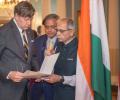
A statement issued by State Department Spokesperson Tammy Bruce said Landau "reaffirmed the United States' strong support of India in the fight against terrorism and the strategic partnership between the two countries".

The brief exchange and handshake between Jaishankar and Sharif took place at a banquet dinner hosted by the Pakistani prime minister at his residence in honour of the delegates attending a summit of the Shanghai Cooperation Organisation.

National Security Advisor Ajit Doval on Monday emphasised the need to counter terrorism in all its forms for overall regional peace and stability during a meeting with Chinese Foreign Minister Wang Yi in Beijing.

India and China reviewed the situation along the Line of Actual Control (LAC) in eastern Ladakh and prepared for the next Special Representatives' dialogue on the boundary question.

Defence Minister Rajnath Singh on Thursday held talks with his Chinese counterpart Li Shangfu and is learnt to have discussed the lingering border row in eastern Ladakh.

Communication channels between India and the US are open to resolve the ongoing tariff issues, and the glitch in trade ties is only temporary, given the long-term relationship between the two nations, government sources said on Wednesday. The US' 50 per cent tariffs on Indian exports to America came into effect from August 27, barring a few sectors.
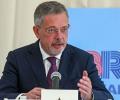
Amidst ongoing efforts to resolve the Russia-Ukraine conflict, Russian Ambassador to India Denis Alipov stated that Moscow is "prepared to sit in a trilateral format" for peace talks. Alipov also expressed optimism about the current US administration's approach to the conflict, suggesting a willingness to engage in dialogue. He highlighted the importance of a peaceful resolution while emphasizing that Russia is prepared to continue the war if necessary. Alipov stated that Russia does not expect anything specific from India in terms of mediation and highlighted the strong bilateral relationship between the two countries.
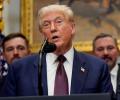
"India is not only buying massive amounts of Russian Oil, they are then, for much of the Oil purchased, selling it on the Open Market for big profits," Trump said in a social media post on Monday.

Qin, who is visiting New Delhi to attend the G20 Foreign Ministers meeting on Thursday, is expected to meet Jaishankar on its sidelines though the foreign ministry here is tight-lipped about it.
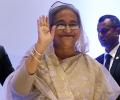
India needs to address Bangladesh's longstanding concerns to improve bilateral ties between Dhaka and New Delhi, Hossain said adding: Bangladesh's previous (ousted) government addressed the concerns of India, but India did not address Bangladesh's concerns.

'While the President has been critical of India, he has gone out of his way to compliment PM Modi. They have an incredible relationship.'

Following the disengagement, both sides will soon start the coordinated patrolling in their respective areas, sources added.
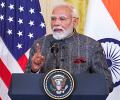
Those who stay in other countries illegally do not have any legal right to be there, Modi said.

Prime Minister Narendra Modi on Thursday said India and Italy have decided to elevate their bilateral ties to a strategic partnership, opening a new chapter on defence cooperation.
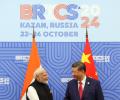
'Don't play the American game... India is too big for a US game.'

In the meeting, Doval conveyed to Wang that peace and tranquillity in border areas and respect for the Line of Actual Control are essential for return of normalcy in bilateral ties, according to the ministry of external affairs.

In an interview with Newsweek magazine of the US, Modi said for India, the relationship with China is significant.

'Tensions and dialogue are likely to go hand-in-hand with China.' 'The goal should be to cultivate power so that one can negotiate from a position of strength.'

"We realise just how important it is for world cricket to have regular matches between Pakistan and India but unfortunately the ICC cannot interfere in this matter as it is a bilateral matter purely between two boards," Richardson told the Express newspaper.
'We believe that in the new world order FTAs or bilateral trade agreements (BTAs) are the way forward.' 'They are enablers for our participation in global value chains. Today, around 70 per cent of global trade is tied to these chains.'
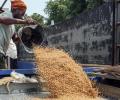
Very sensitive items -- such as apples, which carry political weight and are closely tied to farmer interests in states like Himachal Pradesh and Uttarakhand -- may face restricted concessions.
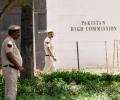
Pakistan is holding a high-level security meeting to formulate a response to India's suspension of the Indus Water Treaty and downgrading of diplomatic ties. The meeting, convened by Prime Minister Shehbaz Sharif, will include the National Security Committee, three services chiefs, and key ministers. The move comes after India blamed Pakistan for a terror attack in Pahalgam, which Pakistan has denied. Diplomatic observers warn that the escalation could further strain relations between the two countries.
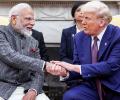
India has firmly rejected any involvement of a third party in its border dispute with China, declining an offer of mediation from US President Donald Trump. Foreign Secretary Vikram Misri emphasized India's commitment to resolving bilateral issues through direct dialogue, stating that New Delhi has always maintained a bilateral approach in dealing with such matters. This stance underscores India's position that the border dispute with China should be addressed through direct negotiations between the two countries.
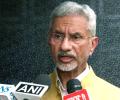
India on Thursday welcomed Kabul's firm rejection of attempts to create distrust between India and Afghanistan during a phone conversation between External Affairs Minister S Jaishankar and acting Afghan Foreign Minister Amir Khan Muttaqi.
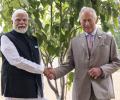
Prime Minister Narendra Modi presented a tree sapling to King Charles III as part of his 'Ek Ped Maa Ke Naam' environmental initiative during their meeting at Sandringham Estate.
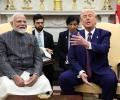
'Trump administration wanted a positive tone at this summit, but there was still some anxiety that there could be some awkward moments -- and there were not.'
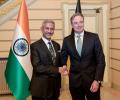
The era where nations thrived through rigid alignments is giving way to an age where the connective State defines power. For India, that era has arrived, points out Dr Nishakant Ojha.

'If Washington has to balance Chinese power, she will have to turn to the third biggest power in the world which is India.' 'The United States and India will have to work together in order to keep Chinese ambitions in check.'
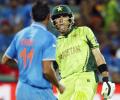
Pakistan captain Misbah-ul-Haq hopes bilateral cricketing ties with India will resume despite the chief of the neighbouring board ruling out the possibility in the near future after the recent attack on an army camp in Kashmir.
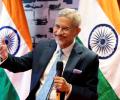
'The logic every one of our neighbours must realise is that working with India will give you benefits, and not working with India has a cost.'
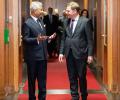
External Affairs Minister S Jaishankar has asserted that India has zero tolerance for terrorism and will never give in to nuclear blackmail, emphasizing that New Delhi will deal with Pakistan purely bilaterally. He made these remarks during a joint press conference with his German counterpart in Berlin, where he also highlighted the importance of the strategic partnership between India and Germany, emphasizing the need for a free trade agreement between the two nations.
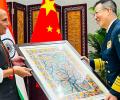
Defence Minister Rajnath Singh, in his meeting with Chinese counterpart Dong Jun in Qingdao on June 26, proposed that India and China should solve the "complex issues" under a structured roadmap comprising steps to de-escalate tensions along the frontiers and rejuvenate the existing mechanism to demarcate the borders.

The meeting between Jaishankar and Zameer in the Ugandan capital city of Kampala came amid an unease in the Maldives' bilateral ties with India.

Prime Minister Narendra Modi concluded his visit to the United States after holding high-level bilateral talks with President Donald Trump on a wide range of subjects, including trade and technology, defence and security, energy and people-to-people ties. The two leaders decided to take a significant step in deepening their strategic ties, particularly in the areas of defence, energy, and critical technology. Modi also met with key American officials, including National Security Advisor Michael Waltz and Director of National Intelligence Tulsi Gabbard, and prominent business leaders like SpaceX CEO Elon Musk and Indian-American entrepreneur Vivek Ramaswamy.
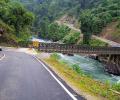
India on Wednesday outright rejected China's attempts to rename some places in Arunachal Pradesh, saying such 'preposterous' attempts will not alter the 'undeniable' reality that the state 'was, is, and will' always remain an integral part of India.

India and China on Thursday vowed to redouble efforts to resolve the remaining issues in eastern Ladakh at the earliest and 'stabilise and rebuild' ties even as External Affairs Minister S Jaishankar conveyed to his Chinese counterpart Wang Yi during a meeting that the Line of Actual Control (LAC) must be respected.
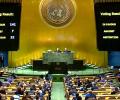
India abstained from a UN General Assembly vote on a resolution regarding Afghanistan, citing the need for a balanced approach that combines incentives and disincentives, and calling for new initiatives to address the humanitarian crisis.

The Indian government has lodged a strong protest with Canada after consular officials at the Indian consulate in Vancouver were informed they were under audio and video surveillance and that their private communications had been intercepted. The Indian government maintains that Canada has provided space for pro-Khalistan elements operating from Canadian soil with impunity and has urged Canada to take action against anti-India elements.
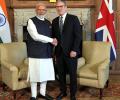
For UK automakers, market access to India will be limited by quantity caps and phased tariff cuts, especially on petrol, diesel and electric vehicles.
